

Our Blogs
How to Rank on Google Maps Dubai and Dominate Local Search
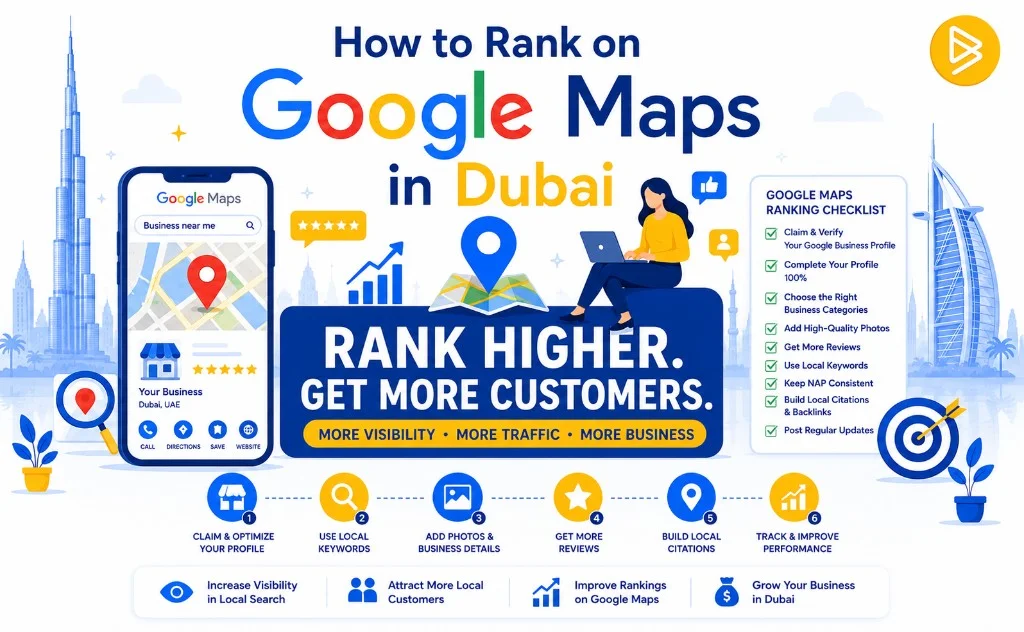
A search for "best gym near me" in Dubai pulls up three businesses before anything else even loads. Those three spots, often called the local pack, get the overwhelming majority of clicks, and everything below them might as well not exist for a customer who's already decided based on what's right in front of them. Learning how to rank on Google Maps Dubai is really about earning one of those three slots, since visibility anywhere else on the map rarely translates into actual walk-ins or calls.
Unlike traditional search rankings, Maps results lean on a different mix of signals entirely. Distance, relevance, and reputation all blend together in ways that aren't always obvious from the outside, which is exactly why so many businesses with great products still sit buried on page two of the map results.
What Actually Moves the Needle: Google Maps Ranking Factors
Three things sit at the core of every Google Maps ranking factors discussion: relevance, distance, and prominence. Relevance asks how well a business profile matches what's being searched. Distance is fairly self-explanatory, though the proximity ranking factor weighs more heavily than most business owners assume, sometimes outweighing reviews or content entirely when someone searches with their location turned on.
Prominence is the broadest of the three and the hardest to game. It pulls from how well-known a business is across the web, how many citations point back to it, the quality of its Google reviews ranking, and how often the listing gets engaged with. A business that's been around for years with consistent online mentions tends to have an edge here that newer competitors have to work harder to close.
Google Business Profile Optimization UAE: Getting the Basics Right
Most ranking problems trace back to a profile that's incomplete or inconsistent, which makes Google Business Profile optimization UAE the obvious starting point. Every field matters more than it seems: business categories need to be specific rather than vague, hours need to stay accurate especially around UAE holidays, and photos should actually represent the current state of the business rather than stock images uploaded once and forgotten.
Posts and updates within the profile also feed into how active and trustworthy a listing appears. Businesses that post offers, events, or updates regularly tend to outperform ones that set up a profile once and never touch it again. It sounds almost too simple, but neglect is one of the most common reasons a perfectly good business gets outranked by a mediocre one that's simply more active.
Map Listing Optimization Dubai Beyond the Profile Itself
Map listing optimization Dubai doesn't stop at the Google Business Profile. Local citations across directories, industry-specific listings, and even social platforms all reinforce the same business details search engines are trying to verify. Consistency here matters far more than volume, a handful of accurate, matching citations across recognized UAE directories tends to outperform dozens scattered across low-quality or irrelevant sites.
Geo-tagged content plays a quieter role too. Photos and even some website content tagged with location data give search engines another signal tying a business to a specific area, reinforcing relevance for searches happening nearby. It's a small piece, but small pieces add up fast in a competitive market like this one.
Google Maps SEO Dubai and the Website Connection
Google Maps SEO Dubai doesn't exist in isolation from the website behind it. A site that loads slowly, isn't mobile-friendly, or lacks basic local schema markup quietly undermines even a well-optimized profile. Search engines cross-reference the website against the listing, so mismatched information, an old address still sitting on a contact page, for instance, can create friction that holds rankings back even when everything else looks fine on the surface.
Location-specific landing pages help here too, particularly for businesses with multiple branches across the city or wider emirate. Each location benefits from its own page with unique, locally relevant content rather than a single generic page trying to represent every branch at once.
The Local Pack Ranking Dubai Businesses Are Fighting Over
Local pack ranking Dubai competition has gotten noticeably tighter over the past couple of years as more businesses figure out the basics. What separates the businesses sitting in that top three from the ones just below usually comes down to consistency rather than any single trick: steady reviews coming in, an active profile, accurate citations, and a website that backs up everything the listing claims.
Business listing optimization, done properly and maintained rather than set up once, is what keeps a business in that top tier rather than slipping out the moment a competitor catches up. Rankings here aren't static. They shift constantly based on who's putting in the work right now, not who did the work two years ago.
Can a Business Without a Physical Office Still Rank?
Service-area businesses without a storefront face a slightly different version of this challenge, but it's far from impossible. Defining a clear service area within the Google Business Profile, gathering reviews from real customers within that area, and building citations that reflect the service region rather than a fixed address can all help. Google Maps marketing UAE for service businesses leans more heavily on reviews and relevance signals since the usual proximity advantage of a physical location isn't there in the same way.
Reviews Carry More Weight Than Most Businesses Realize
Google reviews ranking influence shows up in two ways: the actual ranking boost reviews provide, and the conversion boost that happens once a customer sees a business with genuine, recent reviews next to one with none. Responding to reviews, good and bad alike, signals an active, engaged business rather than one that's simply listed and ignored. Volume matters, but recency and authenticity matter just as much. A profile with two hundred reviews from three years ago often loses to a competitor with thirty recent ones.
Conclusion
Ranking on Google Maps Dubai comes down to consistency across a handful of moving parts: an active, accurate profile, citations that match everywhere they appear, reviews that keep coming in, and a website that backs up every claim the listing makes. None of it happens overnight, and none of it stays finished once it's done, since competitors are making the same moves at the same time. Businesses that treat this as ongoing maintenance rather than a one-time setup tend to be the ones still sitting in that local pack months and years later, while everyone else wonders what changed.
Recent Blogs:
All Your Queries Solved Here
Your satisfaction is our priority; feel free to inquire about any aspect of our best digital marketing service in UAE, and we'll be glad to assist you.
Request a Call BackFrequently Asked Questions
Relevance, distance, and prominence make up the core of Google Maps ranking factors. Relevance measures how well a profile matches the search, distance reflects how close the business is to the searcher, and prominence draws from reviews, citations, and overall web presence.
Reviews carry significant weight in Google reviews ranking and influence both visibility and whether a customer actually chooses that business once they see it. Recent, consistent reviews tend to matter more than a large volume of old ones.
Yes, service-area businesses can still rank by clearly defining their service area, gathering reviews from customers within that area, and maintaining strong citations tied to the region served, even without a fixed storefront address.
Updates should happen regularly rather than just once. Posting offers or news, refreshing photos, and checking that hours and categories remain accurate, especially around holidays, all keep a profile looking active rather than abandoned.
Timelines vary by competition level, but most businesses start seeing movement within two to four months of consistent optimization, with stronger, more stable rankings typically building over six months or longer.
Recent Posts